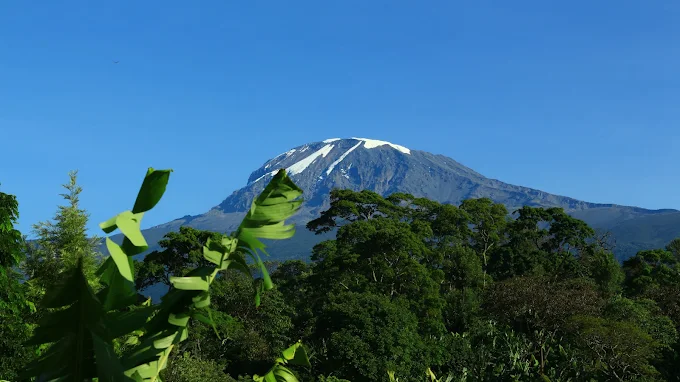
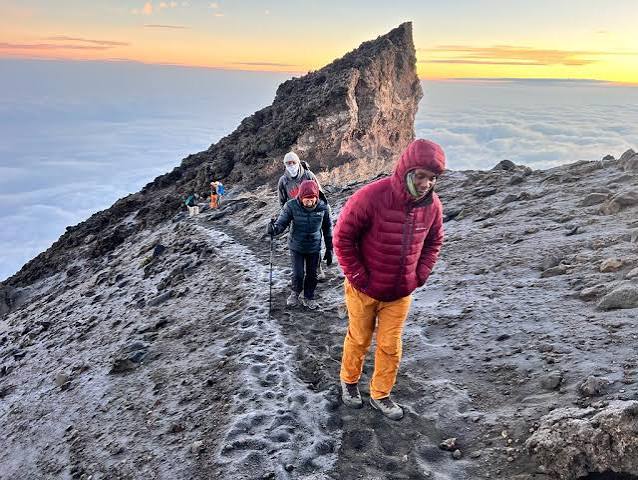
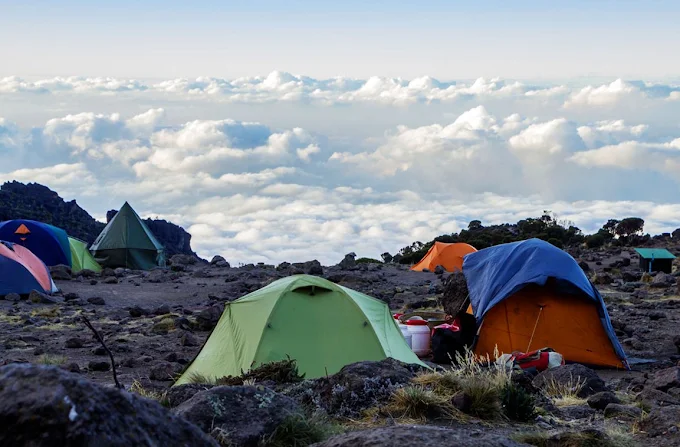
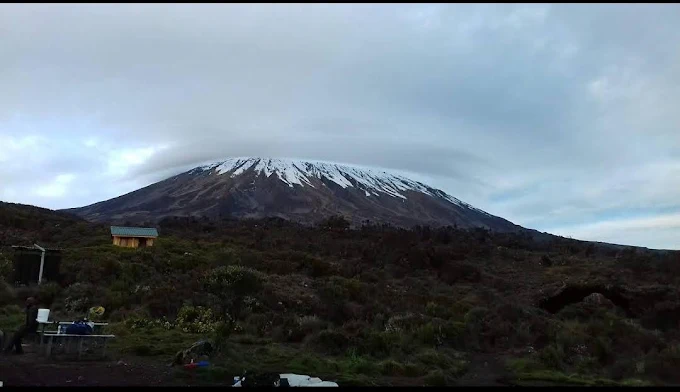
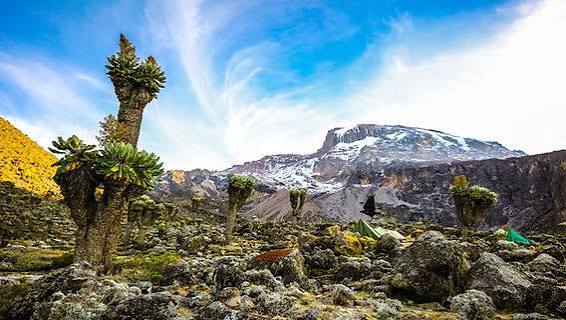
Rongai, being the only way to approach Kilimanjaro from the north, goes through the picturesque views of the rainforest and the second highest point of Tanzania - the Mawenzi volcano. Rongai is great for those travelers who have already got high altitude experience and are willing to escape the crowds of other climbers since this route is quite far from the town. The Rongai Route is a perfect way to test your strength and get unforgettable impressions on the distance of 65 kilometers (40 miles).
Tour Highlights
Only route approaching Kilimanjaro from the north
Scenic rainforest views
Views of Mawenzi Volcano
Ideal for experienced high-altitude trekkers
Less crowded trekking route
Remote and peaceful mountain experience
Total distance: 65 km (40 miles)
Perfect for adventure and unforgettable hiking experiences
What's Included
Included
Rescue fee
Park fees
(For non-residents)
All activities
(Unless labeled as optional)
All accommodation
(Unless listed as upgrade)
Camping equipment
A professional driver/guide
All transportation
(Unless labeled as optional)
All Taxes/VAT
Roundtrip airport transfer
Meals
(As specified in the day-by-day section)
Drinks
(As specified in the day-by-day section)
Not Included
Porterage
Climbing gear
International flights
(From/to home)
Additional accommodation before and at the end of the tour
Sleeping bag
Bath towels
Tips
(Tipping guideline US$10.00 pp per day)
Personal items
(Souvenirs, travel insurance, visa fees, etc.)
Government imposed increase of taxes and/or park fees
Photos
5-Day Itinerary
Nale Moru Village
8 km
3-4hrs
Rongai One Camp
01
Rongai Camp
The climb begins from the attractive wooden village of Nale Moru (1,950 m.) on a small path that wind through fields of maize and potatoes before entering a pine forest. The track then starts to climb consistently, but gently through attractive forest that shelters a variety of wildlife, including the beautiful Kilimanjaro Colobus monkey. These monkeys are black with a long ‘cape’ of white hair and a flowing white tail. The forest begins to thin out and Rongai One Camp is at the edge of the moorland zone (2,600 m.) with extensive views over the Kenyan plains. [3-4 hours walking].
Lunch and Dinner
Budget camping
Activities
Begin the trek at Nale Moru Village (1,950 m).
Walk through maize and potato fields.
Hike through the pine forest and observe the surrounding nature.
Look out for wildlife, including the Kilimanjaro Colobus monkey.
Continue to Rongai One Camp (2,600 m).
Enjoy panoramic views of the Kenyan plains and the moorland landscape.
Carry 2–3 litres of drinking water.
Wear comfortable hiking boots and moisture-wicking socks.
Bring a light waterproof jacket and warm layers.
Carry sunscreen, sunglasses, and a hat.
Bring binoculars or a camera for wildlife viewing.
Pack light snacks for energy during the hike.
Walk at a slow, steady pace to support acclimatization.
Avoid feeding or disturbing wildlife.
Keep your personal belongings and valuables secure.
Rongai One Camp
10km
5-6Hrs
Third Cave Camp
02
Rongai Third Caves
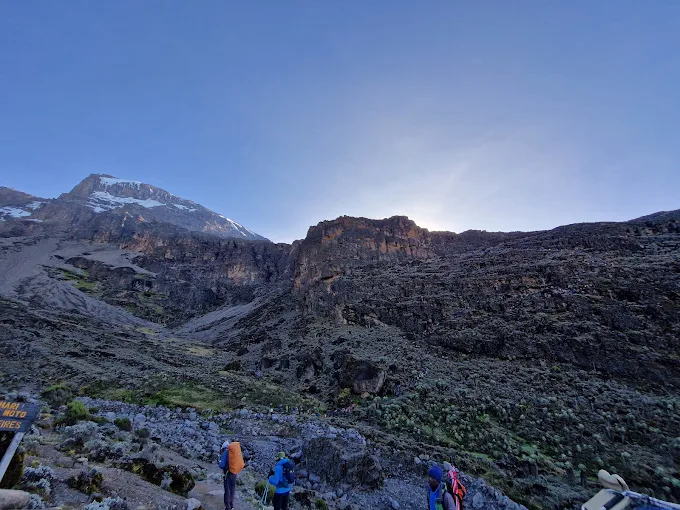
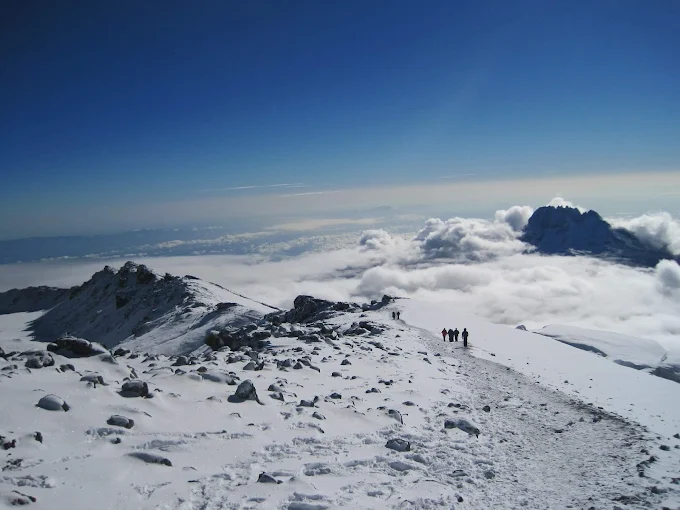
The morning walk is a steady ascent up to the ‘Third Cave’ (3,450 m) with superb views of Kibo and the Eastern icefields on the crater rim. After lunch, we continue up to Third Cave three thousands nine hundred meters (3,900 m)for five to six hours[5-6 hours walking].
Breakfast
Lunch
Dinner
Budget camping
Activities
Hike steadily uphill through the moorland zone.
Enjoy scenic views of Kibo Peak and the Eastern Icefields.
Stop for lunch along the trail.
Continue ascending to Third Cave Camp.
Relax and prepare for the next day’s trek.
Carry 2–3 litres of drinking water.
Bring warm clothing, a windproof jacket, and rain gear.
Wear sturdy hiking boots and comfortable hiking socks.
Carry energy snacks and a packed lunch.
Use sunscreen, sunglasses, and a hat.
Walk slowly to support acclimatization.
Kikelewa Camp
8 km
4-5hrs
School Hut Camp
03
Rongai School Hut
The steady ascend continues, soon reaching the lunar desert of the ‘Saddle’ between Mawenzi and Kibo. We should reach School Hut Campsite (4,750 m.) at the bottom of the Kibo Crater wall by midday. The remainder of the day is spent resting in preparation for the final ascent before a very early night! [4-5 hours walking].
Breakfast
Lunch
Dinner
Budget camping
Activities
Continue the gradual ascent towards the Saddle, the high-altitude desert between Mawenzi and Kibo peaks.
Enjoy views of the lunar-like landscape and surrounding volcanic terrain.
Arrive at School Hut campsite at the base of Kibo Crater's wall.
Have lunch and rest after arrival.
Drink plenty of fluids and eat a nutritious meal.
Prepare climbing equipment, warm clothing, headlamp and snacks for the summit attempt.
Drink enough water and eat well to maintain energy.
Watch for altitude sickness symptoms, including headache, nausea, dizziness, and unusual fatigue.
Keep warm clothing, gloves, a warm hat, and a down jacket ready because temperatures can drop significantly.
Rest after arriving at School Hut and avoid unnecessary physical activity.
Prepare your headlamp, batteries, trekking poles, snacks, and water for the summit attempt.
Have an early dinner and sleep early before the midnight or early-morning summit climb.
Follow the guide’s instructions and report any signs of illness immediately.
School Hut
16 - 20km
11-15hrs
Horombo Hut
04
Uhuru Peak down to Horombo Hut
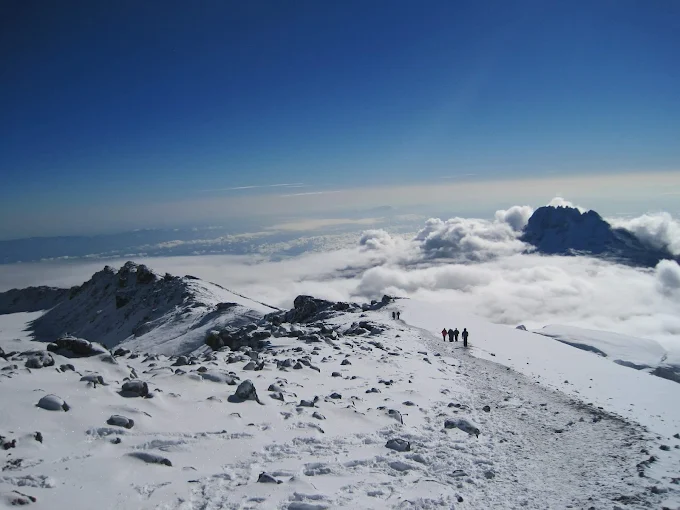
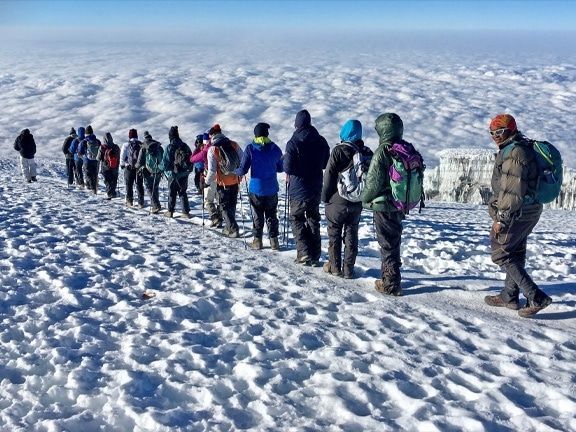
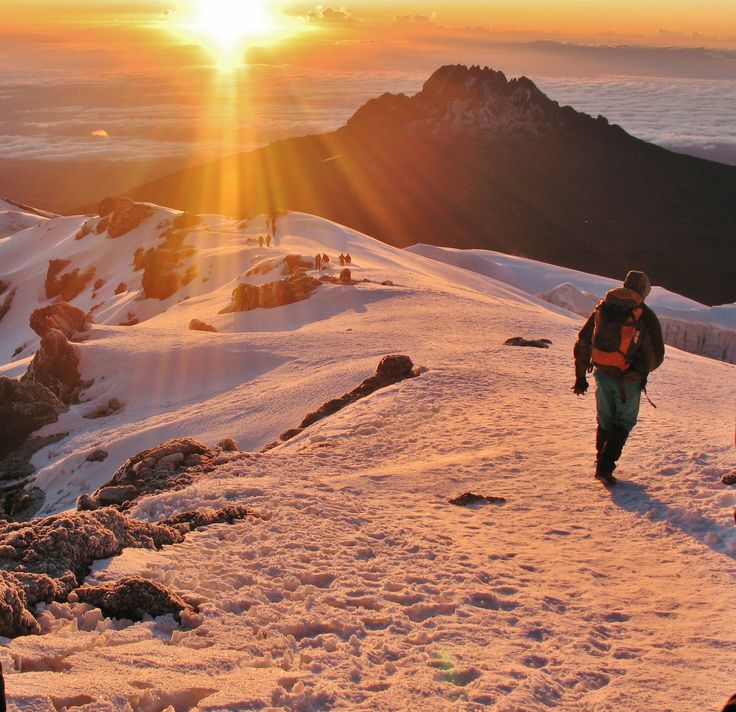
We will start the final and by far the steepest and most demanding, part of the climb by torchlight around 1 a.m. We plod very slowly in the darkness on a switchback trail through loose volcanic scree to reach the crater rim at Gillman’s Point (5,685 m.) We will rest there for a short time to enjoy the spectacular sunrise over Mawenzi. Those who are still feeling strong can make the three hour round trip to Uhuru Peak (5,896 m.), passing close to the spectacular glaciers and ice cliffs that still occupy most of the summit area. The descent to School (4,700 m.) is surprisingly fast and, after some refreshment, we continue the descent to reach our final campsite at Horombo (3,720 m.). [11-15 hours walking].
Breakfast
Lunch
Dinner
Budget camping
Activities
Start the summit ascent around 1:00 a.m. using headlamps.
Climb through volcanic scree to Gillman’s Point (5,685 m).
Enjoy the sunrise over Mawenzi Peak.
Continue to Uhuru Peak (5,896 m), the highest point in Africa.
Take summit photos and enjoy the views.
Descend to School Hut for refreshments.
Continue downhill to Horombo Hut for dinner, rest and overnight accommodation.
Move slowly and follow the guide's pace during the summit climb.
Carry a headlamp with spare batteries.
Wear warm, layered clothing, insulated gloves and a warm hat.
Eat energy-rich snacks and drink water regularly.
Watch for altitude sickness symptoms and inform the guide immediately if they occur.
Use trekking poles during the long descent to reduce pressure on your knees.
Be careful on loose volcanic scree, especially when descending.
Protect yourself from the strong sun with sunglasses, sunscreen and a hat.
Keep enough water and snacks for the entire trek.
Horombo Hut
20km
5-6Hrs
Marangu Gate
05
Horombo down Marangu Gate
A steady descent takes us down through moorland to Mandara Hut (2,700m.), the first stopping place at the Marangu route. We then continue descending through lovely lush forest on a good path to the National Park gate at Marangu (1,830 m.). [5-6 hours walking].
Breakfast and Lunch
Activities
Begin the descent from Horombo Hut through the alpine moorland.
Enjoy views of the surrounding landscape while descending.
Stop at Mandara Hut (2,700 m) for a short rest and refreshments.
Continue descending through the lush montane forest.
Observe the forest vegetation and birdlife along the trail.
Arrive at Marangu Gate, complete park exit procedures and receive summit certificates where applicable.
Meet your transfer vehicle for onward transport.
Walk carefully, especially on steep or slippery sections of the trail.
Use trekking poles to reduce pressure on your knees during the long descent.
Wear comfortable hiking boots with good grip.
Carry enough drinking water and snacks for the journey.
Keep a rain jacket handy because forest weather can change quickly.
Watch your footing on muddy or wet forest paths.
Protect your belongings and keep your camera ready for nature photography.
Allow time for park exit procedures and certificate collection.